The short answer: A water softener removes calcium and magnesium from your water. A salt-free conditioner leaves those minerals in the water and changes how they form crystals so they're less likely to stick. If you want better lather, softer laundry and fewer spots, you need a softener.
How Does a Water Softener Work?
A water softener works by trading places. Water passes through a tank filled with resin beads charged with sodium. Calcium and magnesium are more attracted to the resin than sodium is, so they stick to the beads and sodium is released in their place. What comes out the other side is soft water.
When the resin fills up with hardness minerals, the system regenerates. It rinses the resin with a salt solution from the brine tank, which removes the calcium and magnesium and recharges the beads for the next cycle.
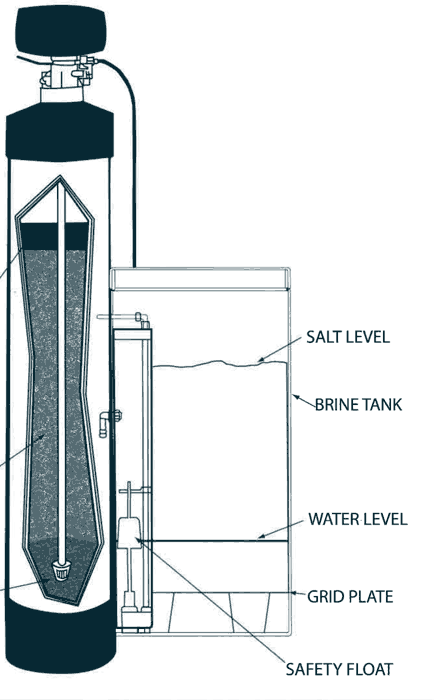
A metered valve, like the one on the Otter Pro Plus, regenerates based on how much water you've actually used instead of on a fixed timer. That means less salt and less water down the drain.
How Does a Salt-Free Conditioner Work?
Salt-free systems, often called template-assisted crystallization (TAC) or conditioners, change how hardness minerals form crystals so they're less likely to stick to surfaces. They don't remove hardness. The calcium and magnesium are still in the water.
Where Does a Water Softener Do More?
Soap and detergent
This is the biggest difference. Calcium and magnesium are what stop soap from lathering and leave curd on your skin, your tub and your laundry. A conditioner leaves those minerals in the water, so none of that changes. In testing, softened water cut the detergent needed for the same clean by up to half in laundry and up to 70% in dishwashing.
How your water feels
The slick, clean-rinsing shower and softer laundry that people associate with soft water come from removing hardness. A conditioner won't deliver that feel.
Spots on glass and fixtures
When minerals are still in the water, they're still left behind when the water dries. You may see less scale inside pipes with a conditioner, but spots on shower doors and glassware largely remain.
Results you can measure
A softener's results can be tested right at your tap, with hardness measured in grains per gallon before and after. Water softeners are also covered by a certification standard, NSF/ANSI 44. Salt-free conditioners don't have an equivalent before-and-after number.
Iron
Softener resin can remove moderate amounts of dissolved iron along with hardness. Salt-free systems generally don't.
What Are the Downsides of Salt-Free Systems?
Salt-free systems are often marketed as a simple, low-maintenance alternative to a water softener. Before you buy one, it's important to understand what they don't do.
They don't actually soften your water
A salt-free conditioner leaves calcium and magnesium in your water. If you test your water after installing one, the hardness reading will be about the same as before. Some are sold as "salt-free softeners," but by industry definition, only a system that removes hardness is a water softener.
Soap and detergent still won't lather well
Because the hardness minerals are still there, soap and detergent keep reacting with them. You can expect the same poor lather, the same soap scum and the same need for extra detergent, shampoo and cleaning products.
Spots and film don't go away
When water dries on shower doors, faucets and glassware, the minerals in it are left behind. With a salt-free system, you'll likely keep seeing white spots and cloudy dishes.
Your skin and hair won't feel different
The clean-rinsing feel people associate with soft water comes from removing hardness. With a conditioner, soap curd can still leave a film on your skin and hair after every shower.
There's no easy way to prove it's working
A water softener's results can be measured at your tap in grains per gallon. Salt-free systems change how minerals behave rather than removing them, so there's no simple before-and-after number. They also aren't covered by NSF/ANSI 44, the certification standard for water softeners.
Iron and other metals can be a problem
Salt-free systems generally don't remove iron, so orange and brown stains can continue. Many salt-free systems also require pretreatment when water contains iron, manganese or other metals, which can coat the treatment media and reduce performance. That can be a concern for many Florida wells.
The media still needs replacing
"No maintenance" doesn't mean no cost. The treatment media inside a salt-free system typically needs to be replaced every few years, and that expense adds up over the life of the system.
When Is a Salt-Free System a Good Fit?
Salt-free systems do have some advantages. There's no salt to buy or carry, no drain line and no regeneration water. For a small number of homes, those benefits can outweigh the downsides above. They may make sense if:
- You live in a condo with no floor drain
- You're on a septic system and would rather not send brine to it
- You're on a sodium-restricted diet
- Your only goal is protecting a tankless water heater from scale
If that describes your home, we'll tell you.
Which One Is Right for Your Home?
For most Florida homes with hard water, a salt-based water softener is the solution that actually removes the hardness. The best way to decide is to start with a water test and see what's in your water.
The Otter Pro Plus comes in at thousands less than the national brands for a comparable install, with a 5-year warranty on tanks, media and valves.